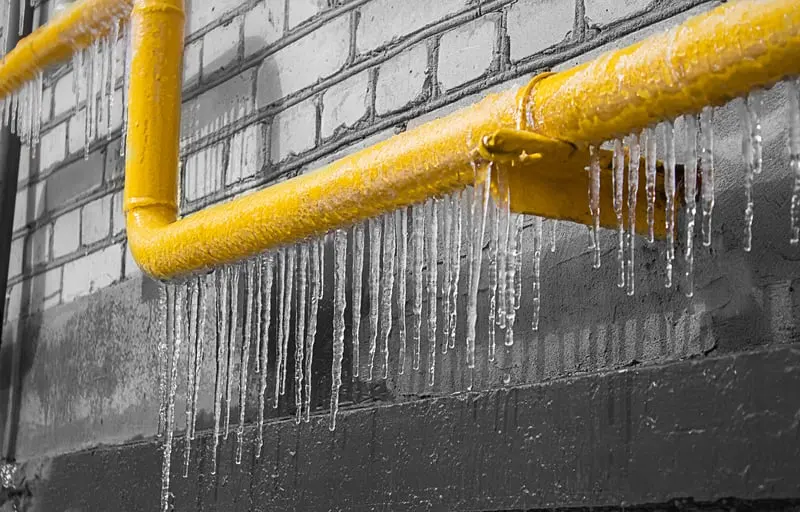
Cañon City is nicknamed the Climate Capital of Colorado, but the numbers still include hard cold: a January average low of 18.4 degrees F and a January record low of 24 degrees below zero. Pipes that run through cold spaces freeze when the cold lasts, and the damage often shows only when the ice melts. A split pipe is a burst pipe water damage job, and the preparation happens before the first hard freeze.
Key takeaways
- The city's design criteria list a frost depth of 27 inches and an outdoor winter design temperature of 5 degrees F.
- NOAA 1991 to 2020 normals show a January average low of 18.4 degrees F, and the January record low is 24 degrees below zero F.
- Pipes in exterior walls, unheated garages and attics, and outdoor faucets freeze first.
- A split pipe often leaks only at the thaw, so the main shutoff should be located before a cold snap.
- A burst pipe in a converted duplex or triplex, or on an empty upper floor, can run unnoticed into the space below.
What the numbers say about freezing in Cañon City
Cañon City sits at about 5,300 feet and is nicknamed the Climate Capital of Colorado. A nickname is not a freeze forecast, and the records show real cold.
The city's climatic design criteria and the NOAA normals put numbers on it.
- January average low: 18.4 degrees F, from NOAA 1991 to 2020 normals.
- January record low: 24 degrees below zero F, in records going back to 1893.
- Winter design temperature: 5 degrees F, the outdoor figure in the city's design criteria.
- Frost depth: 27 inches, the depth the city's design criteria use for ground that can freeze.
- Snow: about 38.3 inches a year in the NOAA normals.
Where pipes freeze first
Wherever a pipe runs outside the heated part of a building, cold can reach it. Pipes buried outside are normally set below the frost depth for the same reason.
- Exterior walls: pipes against cold outside surfaces, especially where insulation is thin or missing.
- Unheated garages, attics and utility spaces: no heat and no protection.
- Outdoor faucets: a hose left attached traps water that freezes and backs into the wall.
- Gaps: pipes near cracks, vents or openings where cold air blows in.
- Empty rooms and floors: spaces where the heat is turned down or off.
Preparing before the first hard freeze
Most freeze damage is preventable with a little work in the fall.
- Disconnect hoses and shut off the supply to outdoor faucets.
- Find the main water shutoff, and make sure everyone in the household knows where it is.
- Insulate exposed pipes in garages, attics and utility spaces, and seal gaps where cold air enters.
- Keep the heat on and steady during a cold snap, including in empty rooms.
- Open cabinet doors under sinks on exterior walls so warm air reaches the pipes.
- Let a faucet drip during severe cold, as a stopgap and not a substitute for heat.
Leaving a building empty
A building left without heat through a stretch of cold weather is the riskiest case. Keep the heat on at a steady setting, ask someone to check inside during a cold snap, or have a plumber shut off the main and drain the pipes before leaving.
A pipe has frozen but not split
A faucet that gives no water, or only a trickle, in freezing weather usually means a frozen pipe. Acting before the pipe splits can prevent the damage.
- Open the faucet so water can flow as the ice melts.
- Warm the pipe slowly with a hair dryer or warm towels, working toward the faucet.
- Never use an open flame or a torch.
- If a pipe is bulging, cracked or leaking, shut off the water at the main.
- Call a plumber if the frozen section cannot be found or does not thaw.
The thaw is when the damage shows
A pipe that splits while frozen often does not leak until the ice melts and water flows again. The first sign can be the sound of running water, a drop in pressure or a stain spreading on a ceiling.
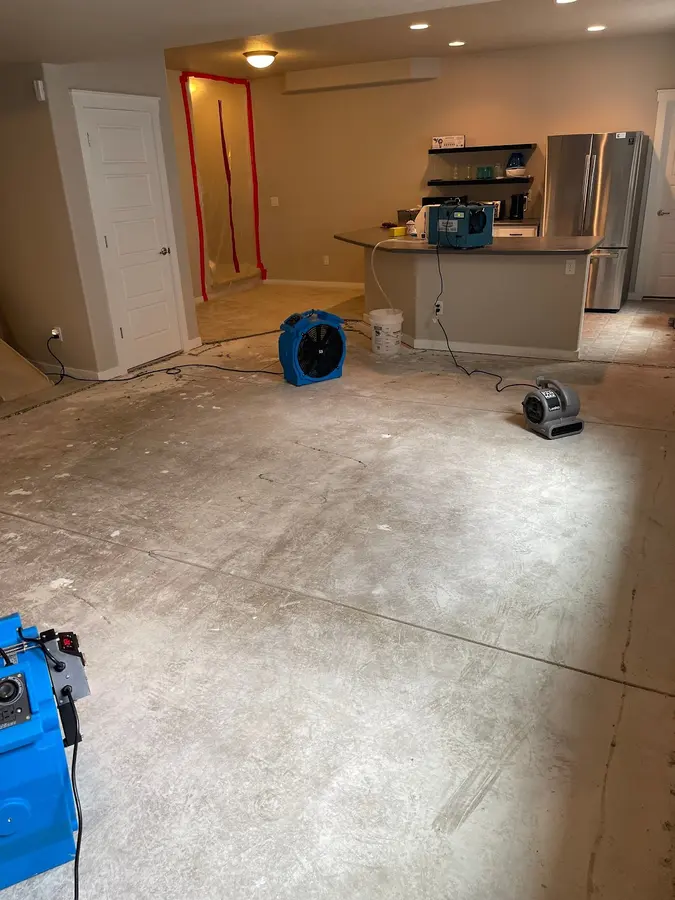
Shut off the main, open a faucet to drain the pipe, keep power off in wet areas and photograph the damage. Then water extraction limits how far the water spreads, and a frozen pipe water damage team dries the walls, floors and ceilings it reached.
Mold can begin to grow within 24 to 48 hours in wet drywall and insulation, so the drying starts early and the readings are logged each day.
What the drying team does
- Extraction: standing water is pumped or vacuumed up.
- Moisture mapping: meters and thermal imaging show wet walls, floors and ceilings.
- Removal: saturated insulation and drywall that cannot be dried come out.
- Drying: air movers and LGR dehumidifiers run until readings reach a dry reference.
- Records: daily readings and photographs go into the claim file.
Who repairs what after a split pipe
A plumber repairs or replaces the split pipe, and a restoration team handles the water: extraction, drying and records. The two jobs overlap in time, and neither has to wait for the other.
In Cañon City, plumbing permits and inspections are issued by the State of Colorado Department of Regulatory Agencies (DORA), not the city Building Department, and a plumbing contractor hired by a homeowner is responsible for getting the permit.
Older housing, rentals and empty floors
The city's 2024 Housing Demand Study puts the median home age in Cañon City at 1973, the oldest in its regional study area, and says 24 percent of housing was built before 1939.
Rentals add a second layer. The city's rental rate was 31 percent in 2022 against 25 percent for Fremont County, and most rentals outside the apartment properties are single family homes converted to duplexes or triplexes, plus manufactured homes.
A split pipe in a converted duplex or triplex can reach more than one household, so tenants tell the landlord at once, in writing, with photographs.
Downtown, the city describes 80 historic two story structures, many with empty and unoccupied upper stories. Wherever an upper floor sits empty, a pipe can freeze and split with nobody there to notice, and the water then runs into the floor below.
A water damage restoration team in Cañon City dries every level the water reached.
Questions
How cold does it get in Cañon City?
NOAA 1991 to 2020 normals put the January average low at 18.4 degrees F, and the January record low is 24 degrees below zero F, with records going back to 1893.
What is the frost depth in Cañon City?
The city's design criteria list a frost depth of 27 inches, along with an outdoor winter design temperature of 5 degrees F.
Should a faucet be left dripping?
During severe cold a slow drip keeps water moving in a pipe at risk, which makes freezing less likely. It is a stopgap and not a substitute for heat and insulation.
What should be done when a pipe has split?
Shut off the water at the main, open a faucet to drain the pipe, keep power away from wet areas, photograph the damage and call a plumber and a restoration team.
Does homeowners insurance cover frozen pipe damage?
Many policies cover sudden water damage from a burst pipe, but conditions vary. Read the policy wording and ask the insurer before work starts.