Structural Drying and Dehumidification in Pueblo, CO
After extraction, the drying team dries framing, subfloor, plaster and basement concrete with air movers and LGR dehumidifiers, and logs readings every day until materials match a dry reference.
(888) 532-8620Get the structural drying started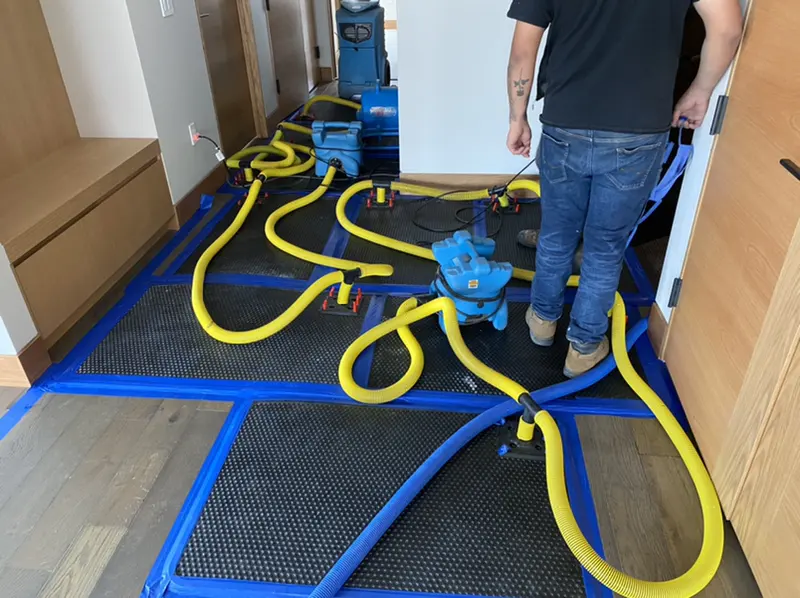
First steps for structural drying and dehumidification in Pueblo
- Leave the equipment running. Air movers and dehumidifiers work around the clock. Switching them off at night adds days to the drying.
- Keep doors and windows closed. The drying team sets up a closed drying area, and open windows let outside air throw off the plan.
- Keep drain hoses clear. Dehumidifiers drain through a hose. Keep it clear and pointed at a drain or sink.
- Keep the heat on. Keep the thermostat at a normal setting. Cold rooms dry slowly.
How the restoration team approaches structural drying and dehumidification
Surfaces dry long before the structure does. Framing, subfloor, plaster and concrete hold water a hand cannot feel, and that water keeps feeding damage after the room looks fine. Structural drying removes it, and readings, not the calendar, decide when it is done.
What does structural drying and dehumidification cost in Pueblo, CO?
Structural drying in Pueblo typically runs $1,000 to $7,500, set by how many rooms need equipment, how many days it runs and whether dense materials like hardwood or basement concrete need specialty drying.
One or two rooms
- Air movers and one dehumidifier
- Three to five days
- Daily readings
Basement or several rooms
- Several dehumidifiers
- Wall cavity drying
- Psychrometric logs
Hardwood, plaster or Class 4
- Desiccants or floor mats
- Longer equipment time
- Dense materials
Ranges are typical, not a quote: the category of water, square footage, material class and how fast drying started move the number most. Run the Pueblo water damage cost calculator for a closer range.
How structural drying and dehumidification is handled in Pueblo
Moisture gets mapped before any equipment goes down, so the drying plan matches what is actually wet. Equipment stays until the readings say dry, not until it looks dry.
Map the moisture
Meters and thermal imaging map every wet material and set the dry reference.
Set the equipment
Air movers and dehumidifiers get sized to each room's class of loss and evaporation load.
Monitor daily
The drying team takes readings every day and moves or adds equipment as materials dry.
Confirm dry
Equipment comes out only when materials read within 2 to 4 points of the dry reference.
Drying in Pueblo's climate
Pueblo's outdoor air is dry most of the year, which helps rooms above grade. Basements are a different story: the slab and block walls stay cool, cool air holds less moisture, and dense materials release water slowly. LGR dehumidifiers keep pulling water out of cooler air, and desiccant units take over for dense concrete and plaster. During the July and August monsoon the outdoor air is more humid, so the drying team keeps the work area closed and dehumidified.
Drying equipment and what it does
- Air movers sweep moist air off wet surfaces, set to each room's evaporation load
- LGR dehumidifiers pull water out of the air even at lower temperatures
- Desiccant dehumidifiers dry very dense materials and cold spaces
- Floor drying mats and panels pull water out of hardwood
- Wall cavity systems push dry air into closed walls through small holes
The EPA indoor air quality site explains why indoor moisture needs to stay under control, and Colorado State University Extension publishes guides for Colorado homes.
How dry is dry
IICRC S500 is the industry drying standard. The drying team takes a reading from a dry, unaffected material of the same kind in the same home, then dries wet materials until they read within 2 to 4 points of that reference. Daily psychrometric logs record temperature, humidity and moisture content, which is the record an adjuster reads.
Standing water comes out first through water extraction, and the drying time estimator gives a typical window.
Structural drying and dehumidification across Pueblo and Pueblo County
Pueblo Water Damage Restoration covers ZIP 81009, 81010, 81011 and 81012, from the Northside and Mesa Junction to Bessemer, the East Side, Belmont, Sunset Park and the homes around Lake Minnequa.
Nearby coverage reaches Pueblo West, Blende, Salt Creek, Vineland, Avondale and St. Charles Mesa.
See every Pueblo neighborhood and ZIP coveredRelated to structural drying and dehumidification in Pueblo
Structural Drying and Dehumidification questions in Pueblo, CO
Still dealing with it?
Surfaces dry first; framing and concrete need readings and equipment. Call and the drying team sets it up.
(888) 532-8620 Get the structural drying startedWhy can't I just use fans?
Household fans move air but do not remove moisture from it. Without dehumidifiers, the water evaporating from the structure stays in the room and soaks back in.
How long does structural drying take?
A contained Class 1 or 2 loss usually dries in three to five days. Hardwood, plaster, basement concrete and Class 4 losses take longer.
What is a dry reference?
A reading from an unaffected material of the same kind in the same home. Wet materials are dried until they read within 2 to 4 points of it.
Why is the equipment so loud?
Air movers push a lot of air to speed evaporation. The noise is part of the process, and turning them off slows the drying.
Does Pueblo's dry climate mean less equipment?
Dry outdoor air helps upstairs, but a closed-up house and a cool basement still need dehumidifiers. The drying team sizes equipment to each room.
What do the daily logs show an insurer?
They record temperature, humidity and moisture readings every day, showing that the structure was dried to the standard before the equipment left.
Wet framing or floors in Pueblo? Get them dried right.
Drying by the readings keeps hidden water from causing damage later. The drying team logs every day until it is done.
(888) 532-8620Pueblo structural drying, any hour