Structural Drying in Cañon City, Colorado
Surfaces can feel dry while framing and subfloors stay wet. Cañon City crews place air movers and dehumidifiers, then take readings until every material meets its dry goal. Calls run 24/7.
(888) 532-8620Call about Cañon City structural drying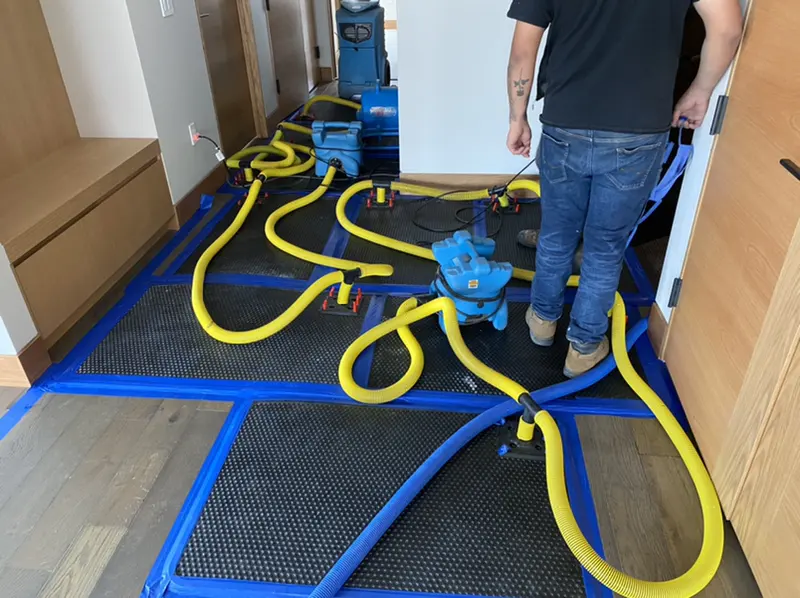
First steps for structural drying and dehumidification in Cañon City
- Stop the source. Make sure the leak or flood source is shut off, since drying cannot catch up with water still arriving.
- Keep doors closed. Close doors and windows in the wet area so the equipment can control the air being dried.
- Leave equipment running. Do not switch off air movers or dehumidifiers early, because a cavity can still be wet when the room feels dry.
- Keep the readings. Save the drying log and photos from each visit, since they show the insurer how dry goals were met.
How the restoration team approaches structural drying and dehumidification
Water that has been removed is only half of a recovery. What remains is moisture inside wood, drywall, insulation and concrete, and that moisture has to be brought down to a measured dry goal before the building is closed up.
What does structural drying and dehumidification cost in Cañon City, CO?
Structural drying in Cañon City usually costs $1,000 to $3,000 for one or two rooms, $3,000 to $7,500 for a basement or several rooms, and $7,500 and up for hardwood, plaster or heavy saturation.
One or two rooms
- Air movers, one dehumidifier
- A few days of drying
- Daily readings
Basement or several rooms
- Multiple dehumidifiers
- Inside wall drying
- Humidity logs
Hardwood, plaster or heavy loss
- Floor mats or desiccants
- Extended equipment time
- Dense materials
Ranges are typical, not a quote: the category of water, square footage, material class and how fast drying started move the number most. Run the water damage cost calculator for a closer range.
How structural drying and dehumidification is handled in Cañon City
Moisture gets mapped before any equipment goes down, so the drying plan matches what is actually wet. Equipment stays until the readings say dry, not until it looks dry.
Baseline
Temperature, humidity and moisture readings are recorded at marked points, and dry goals are set for each material.
Set equipment
Air movers and dehumidifiers are placed to match the wet area, with extra units for framing or hardwood.
Check daily
The same points are read at each visit, and equipment is moved, added or removed as the numbers change.
Release
Equipment is removed once every material has reached its goal, and the final log is shared.
A dry climate does not mean fast drying
Cañon City is semiarid, and the July average high is 89.2 F, yet water trapped in a wall cavity or under flooring has little way out. Surface air can feel comfortable while framing and subfloors stay wet, which is why readings, not touch, decide the finish.
The city's housing study puts the median year built at 1973, so many buildings carry decades of finishes, insulation and framing that all need to dry together.
What the equipment and readings do
- Air movers push dry air across wet floors and wall bases
- Dehumidifiers pull water vapor out of the air and the materials
- Moisture meters track wood, drywall and concrete at set points
- Thermometer and hygrometer readings show whether the room is drying
The equipment count comes from the size of the wet area and the class of the loss, not from a standard package.
How the drying log works
On the first visit the crew records temperature, relative humidity and moisture readings at marked points and sets a dry goal for each material. At every visit after that the same points are read, and equipment is moved, added or removed to match.
Drying follows water extraction on most jobs, and the drying time estimator gives a rough window before equipment is set. Calls are taken 24/7, since a wet building keeps absorbing at night.
Structural drying and dehumidification across Cañon City and nearby communities
Drying crews set up across Cañon City, including downtown, the Riverfront, Dawson Ranch, South Cañon, North Cañon and Northeast Cañon, plus neighboring Lincoln Park, for ZIPs 81212 and 81215.
The same service nearby: structural drying and dehumidification in Pueblo, Florence, Fountain.
Related to structural drying and dehumidification in Cañon City
Structural Drying and Dehumidification questions in Cañon City, CO
Still dealing with it?
Not sure whether a room is really dry? Describe the loss and the rooms involved, and a technician explains how readings settle it.
(888) 532-8620 Call about Cañon City structural dryingHow do crews know when a building is dry?
Moisture meters read wood, drywall and concrete and compare each reading with a dry reference. Equipment stays until every point meets its goal, not until the room feels dry.
Does low humidity mean things dry on their own?
Not reliably. Cañon City is semiarid, but moisture trapped in framing, subfloors or behind cabinets has little way out, and it can linger or support mold.
How long does structural drying take?
Most jobs run several days. Light losses finish sooner, while hardwood, plaster or heavily soaked materials need longer. The drying time estimator offers a rough estimate.
Why do dehumidifiers run along with air movers?
Air movers push moisture from surfaces into the air, and dehumidifiers pull it back out. Running one without the other leaves the room humid or the materials slow to dry.
Can floors and cabinets be dried in place?
Often yes, using floor mats, small drilled openings or removed toe kicks to move air behind the surface. Hardwood and plaster dry slowest, and some pieces may still need replacing.
What does the drying log show?
It records daily temperature, humidity and moisture readings, the equipment placed and the dry goals, giving an insurer a clear record of how the building dried.
Dry to the touch is not the same as dry
Measured drying with daily readings returns a Cañon City building to its dry goals before anything is closed up.
(888) 532-8620Cañon City structural drying help